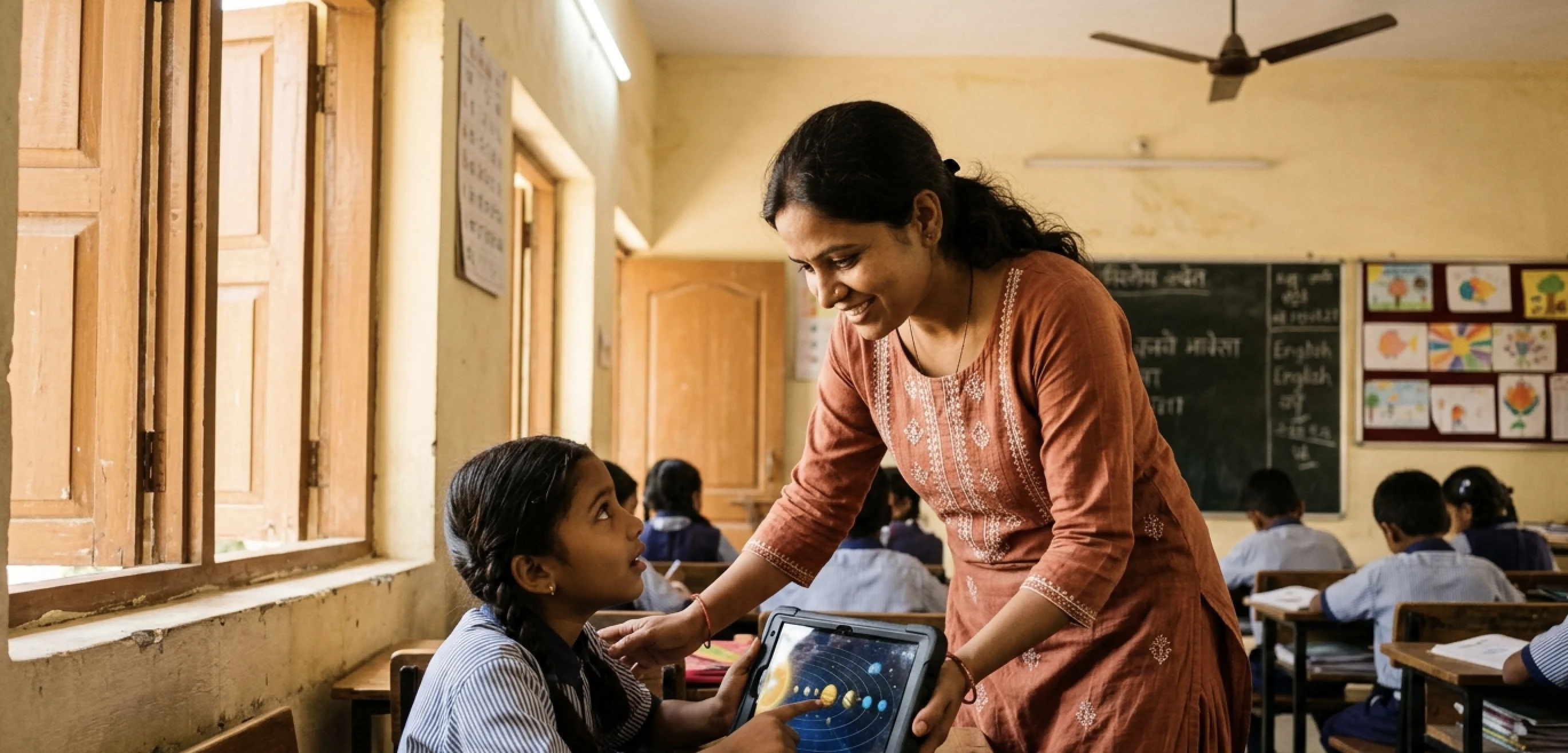
On October 29, 2025, India's Department of School Education and Literacy made a decision that will land on the desk of nearly every schoolteacher in the country. Artificial Intelligence and Computational Thinking will become mandatory subjects from Class 3 onwards, starting with the 2026-27 academic year.
This is not a pilot. It is not an optional skill module sitting quietly in the timetable. It is a national mandate covering roughly 1.5 million schools and 8.5 million teachers. And if you teach in India, the most useful question right now is not "is this happening" but "what does it actually ask of me, and can I realistically deliver it."
Let us walk through that honestly.
What Is the New AI Curriculum?
India is making AI and Computational Thinking (AI and CT) a compulsory part of the curriculum from Class 3, beginning in the 2026-27 session. Classes 3 to 8 start first. Classes 9 and 10 follow in 2027-28. The rollout was finalised in a stakeholder consultation that brought together CBSE, NCERT, KVS, NVS and outside experts, and the curriculum framework is being developed by an expert committee chaired by Professor Karthik Raman of IIT Madras, with NCERT reviewing the draft.
The important nuance: AI is being treated as a basic universal skill, not a specialised technical subject. The Ministry of Education has framed it around the idea of "AI for Public Good," which means the emphasis falls on ethical use, social responsibility and critical thinking rather than turning Class 3 students into programmers. For the youngest learners, Classes 3 to 5, the approach leans on interactive, hands-on learning to introduce basic concepts.
That framing matters for teachers, because it tells you what you are really being asked to teach. Not Python. Judgment.
What Teachers Are Actually Expected to Do
Here is where the policy gets real. AI and CT will be embedded across subjects rather than treated as a standalone elective for a handful of senior students. That is a meaningful shift. A primary teacher who has never thought of themselves as a "tech teacher" is now in scope.
This builds on foundations that already exist. CBSE offers AI as an optional subject in Classes 9 to 12, and the 15-hour SOAR (Skilling for AI Readiness) module already runs in more than 18,000 CBSE schools for Classes 6 to 8. The new mandate takes that base and makes it compulsory, starts it younger, and spreads it across the curriculum.
For most teachers, the day-to-day reality will be introducing AI concepts in age-appropriate ways, helping students understand how these tools work and where they fail, and modelling responsible, transparent use. The technical depth expected of a Class 4 teacher is low. The pedagogical confidence expected is not.
The Part Nobody Is Saying Loudly Enough: the Training Gap
This is the honest centre of the whole story. The government's own officials have said it plainly. India needs to train over 10 million teachers to deliver this. The secretary of the Department of School Education and Literacy put it directly: the challenge is reaching more than one crore teachers and preparing them, and it needs to move fast.
The training is meant to flow through NISHTHA, the national teacher development platform, using video-based, grade-specific modules. SOAR also includes a 45-hour AI for Educators module covering AI pedagogy, classroom tool use, project design and ethics. DIKSHA will carry digital content out to teachers, including those in low-bandwidth areas.
That is a serious infrastructure. It is also a genuinely enormous undertaking, and the timeline is tight. The plain truth is that government-led training will reach teachers at very different speeds depending on where they teach. Teachers and schools that wait to be reached will likely be teaching the curriculum before their training catches up. Teachers who start building their own confidence now will be steadier when the term begins.
How It Fits the Bigger Picture
None of this is happening in isolation. The mandate is aligned with the National Education Policy (NEP) 2020 and the National Curriculum Framework for School Education (NCF-SE) 2023, and it sits inside the broader Viksit Bharat 2047 vision of a future-ready, inclusive education system. The Union Budget 2025-26 also backed it with a Centre of Excellence in AI for Education.
India is not alone here either. Singapore is training teachers across all levels on AI in education by 2026, and Hong Kong has required AI education for junior secondary students since 2023. A clear majority of countries are now building AI education into their school systems. India's version stands out mainly for its scale and for starting at Class 3.
What Teachers Can Do Now to Prepare
You do not need to wait for a module to arrive. A few practical, low-pressure starting points.
Get comfortable using one or two AI tools yourself, the way your students eventually will. Familiarity is most of the battle, and it is hard to teach responsible use of something you have never touched.
Focus on the "why" and the "when not to," not the technical mechanics. The curriculum cares about ethics, judgment and transparency. Those are things experienced teachers are already very good at teaching, just in a new context.
Talk to colleagues and build a small shared bank of what works. Most useful classroom AI practice in 2026 is being figured out by teachers, for teachers, in real time.
Keep your expectations of yourself reasonable. The mandate is a floor, not a finished standard. Nobody expects a perfect AI classroom in term one.
The teacher-readiness gap is real, the government has admitted as much, and it is exactly the kind of problem we built thegurucool to help with: practical, teacher-first AI professional development that does not assume you already speak fluent machine learning. If you want to be ready before the term starts rather than scrambling during it, join the teacher waitlist and we will keep you in the loop as we open up.
The mandate is coming either way. The teachers who treat the next few months as preparation time, not panic time, are the ones who will walk into 2026-27 calm.
Related reading: Private School Teachers in India Are Burning Out. Here's Why. · What Does Medicine Know About Professional Development That Teaching Still Hasn't Figured Out?